Archive for: October, 2010

Media Blitz: Part 1 of 1.

A while ago, Amy Feezor (who writes an awesome blog of her own, by the way!) asked me if I would participate in an interview series called The Playlist for the Herman Miller blog, Lifework! Yes, that Herman Miller. The one who made both of my beloved Eames chairs and has manufactured some of the most influential designs in the world for almost a century– essentially, all the pretty stuff I dream about at night. Well shucks.

The interview is all about my workspace and music taste, and how the two relate. It went up today, so make sure you click over and check it out! It’s like a window into my mind: so lots of gabbing about myself and things I like. Also, never before seen pictures of my desk corner (I know, try to catch your breath). So come on. Click click. Don’t be lazy.

A note: I spent a good long time putting this playlist together, so think of it like a mixed-tape. I invite you to download all the songs and listen to them in that order. I’m more of a full-album-listener in general, but this playlist is, well, really fucking good. You’re gonna love it. You’re welcome, in advance.

Happy listening, darlings.

p.s.- what do all you stylish cool people boogie down to? I’m always on the search for more things I can belt out in the shower.

Life
Tagged:

Pipe & Ply.

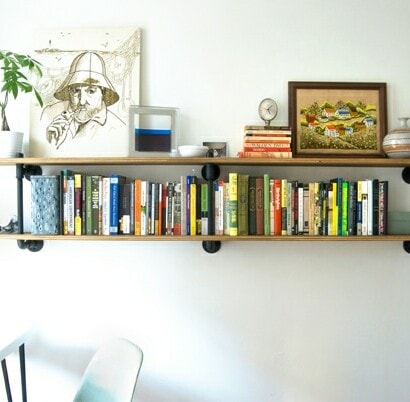
First, the Ace Hotel did it. Then The Brick House figured it out for the massesHindsvik did it. Five 2 eight did it. Now, I did it. Except miniature. Super long post alert, I hope you’re on your lunch hour. Check it, yo:

More pretty pictures at the bottom, fyi.

My whole workspace was sort of lacking in the storage department. I unpacked my books about 5 minutes after moving in back in May, and then shuffled them around my room in various precariously teetering stacks while I figured out a storage solution. I came this close to just biting the bullet and ordering one of those vertical CB2 Array bookcases, but at $189 for only five vertical feet (meaning I would have needed to get rid of some books or buy two bookcases), it wasn’t the most practical choice. And there’s no space for a real grown-up sized bookcase anywhere. Also, apparently I’m addicted to building my own furniture.

Since I can’t screw into our wood floors, I needed to figure out how to properly support this as a wall-mounted endeavor. I don’t know much about anything, but I tried to be aware of the weight and design a suitable bracket accordingly. This, gentle readers, was a feat of engineering. There were several drawings that worked on paper but couldn’t be constructed in real life and a good hour spent in Home Depot screwing different formulations of piping together like a confused, frustrated toddler. About 45 minutes in I was sitting on the floor, surrounded by plumbing bits and stupidly screwing T’s into 10″ pipes when another shopper approached me. It turned out he was also building shelves and wanted to get chatty about it, but I wasn’t in the mood. He was one of those strangers who didn’t get it, the kind who can’t take the hint and leave you alone with your tinker toys.This was Go Time, I was in the zone. He explained his shelving plans and asked about mine. I tried to explain my plan, but at that point I was mostly nonverbal and flustered so he just kind of nodded and smiled, the way you do shortly before walking away when you realize normal-looking people are crazy. It wasn’t fair, really– I came to Home Depot because I knew nobody would bug me. The employees would make themselves scarce, I assume all smoking pot in a back room, complaining about their jobs and plotting new schemes to piss people off. They wouldn’t give two shits that I was ripping the plastic packaging off every little piece of pipe for my own benefit. Sometimes you need that.

After Mr. Talkative was out of my hair I got back to business and eventually came up with this little ditty:

So simple, so obvious. So here’s what you need. Note: those small pipes are actually called “nipples,” but I will hereafter be referring to them simply as “pipes” for obvious reasons, giggling to yourself at work chief among them. They are all 1/2″.

  • 10″ pipe: 3
  • 2″ pipe: 6
  • Tees joints: 9
  • Elbow: 3
  • Close pipe: 9
  • Endcap: 3
  • Flanges: 6
  • One can matte-black spray paint
  • 24 hefty screws (preferably already black)
  • 2 planks of wood (mine are 7″x74″)

I definitely didn’t want the shelf to be very deep, just deep enough to accommodate my more sizable books.

THE STEPS:

1. Buy all your pipes, clean them well with Murphy’s oil soap, let dry, and spray paint them black.

2. Since it would really blow if this thing fell, I invested in a studfinder, which totally sounds like an online dating service for gay guys. In fact it’s a sweet tool that can, through witchcraft, detect the studs under your drywall. It was about $20 and totally worth it for the peace of mind. Especially in an old building, you can’t assume that the studs are standard distances from each other. Mark the center of your studs.

3. A level is a great tool to have for nearly anything in life, but especially for this (a real one, not the iPhone app which I’m pretty sure is a prank). Figure out how high you want your bottom flange to be off the floor and mark it. Then use a level to mark the rest of them. I lined up the bottom screw hole with the mark on the wall and hung all of the flanges so two screw holes would always form a vertical line (and therefore be affixed to the stud at the strongest point, the center). After your bottom flanges are in place, center your level vertically over your bottom flange and draw a line in pencil ten inches above your bottom flange. You’ll need this later (step 5)

4. Screw your closed pipes, your tee joints, the 2″ pipes and the elbows into your bottom flanges. The point of the tee is that it creates a level surface for your shelf to lay on. Then lay your wood on top, trace around the top of each elbow joint from underneath with a pencil. Remove your wood, use a paddle bit or hole saw (I used a 15/16″ paddle bit) to drill through where you just marked. I’d recommend a hole saw since the paddle bit can make your wood a splintery mess, as I found out.

5. Put your wood back, screw in your vertical 10″ pipes, the tee, the 2″ pipe, the other tee, and the closed pipe.

6. Now, getting it all on the wall is kind of tricky. I loosened all the screws on the bottom flanges about an inch so the whole thing could kind of fall back from the wall a bit (it’s a good idea to have two people for this part, Eva held the shelf up while the screws were all loose), which gives you the space you need to attach the top flanges. Re-tighten your bottom screws and affix the top flanges to the wall, the top and bottom screw holes lining up with the vertical line you made earlier. Sorry there aren’t pictures, it was kind of all hands on deck.

7. Lay your top shelf, making sure the edges line up with the bottom shelf. Trace the holes and drill. Lay it back on top and screw in your closed pipes and end caps through the holes.

Phew, the hard part is over. Now onto those finishing deets:

I insisted on using plywood because I love that exposed edge, which ended up being an expensive headache. Home Depot in Manhattan doesn’t sell 4′x8′ sheets of anything, so I went to Prince Lumber. First, they didn’t like that I was building my own bookshelves instead of just buying some. Then they didn’t like that I wanted plywood instead of the much cheaper wood planks. They especially didn’t like that I wanted 1″ thick plywood and eventually talked me into using 3/4″ instead. They didn’t like that I needed them to cut it down to 7″x74″ strips. They didn’t like that I didn’t want my scraps, even though I might as well take them because I paid for them. I’m pretty sure they just didn’t like me, which is odd because I’m so wonderful. Eventually we settled on 3/4″ thick Canadian Birch plywood, which they assured me would be strong enough for the load and wouldn’t bow. Then they called me a trust fund baby at checkout. My new wood planks had to go through that plexiglass window in the cab on the way back. It was harrowing.

Anyway. I really like plywood. It reminds me of sweet furniture I can’t afford. I taped off the top and b0ttom and used one coat of Minwax Fruitwood 241 on the edges.

Then I used glossy polyurethane over just the edge. I used about 4 or 5 coats, since the first two kind of just get sucked in and I really wanted to seal the edge well for what comes next.

Okay. You know when you’ve read something a really long time ago and then it just pops into your head and you feel weird about remembering it? That’s what happened with the description of this awesome black floor that Anna from Door Sixteen posted forever ago:

So I figured I’d try it, because that is sick. The process involves letting steel wool steep in vinegar, the resulting liquid of which forms a chemical reaction with the tannin in the wood to turn it a grey/black, the darkness depends on the amount of tannin in the wood and the number of coats you do.

The steps were:

  1. Take some steel wool, put it in the bottom of an empty parmesan cheese container.
  2. Pour in white vinegar.
  3. Let soak 24 hours.
  4. Strain into a cup to remove any metal bits, which will rust if they get painted onto the wood.
  5. Get to painting (I used a small foam brush).

Be careful with this stuff, since I found that any errant drips (like on my walls!) left a reddish stain wherever they dried.

I’m not sure quite where I went wrong– I painted SEVERAL samples on scrap pieces, all of which turned out a delicious silver grey, but the shelves themselves definitely came out a sort of greyish-brownish. I topped it with a coat of tung oil (what you see on the right), which might have made it browner? It’s still a pretty cool finish, though not exactly what I was going for. I’m still going to count it a success since vinegar and steel wool changed the color of the wood so much. Like, slow down science, you’re blowing my mind.

Then, dress it up! Of course I just HAD to clutter the top up with too much stuff, some of which has already been edited out. I just got so excited.

I like the idea of the bottom shelf being for books and the top shelf being a nice forum for a rotating display of art and objects. Those are my boring nerdy school books, the cool stuff is on the other side.

Yeah, I switched the picture above the desk to something smaller. It feels more balanced and makes room for the desk lamp, which had to switch sides so the right side of the desk wouldn’t look a hot mess.

There wasn’t a graceful place to put this, so here it is. The budget breakdown:

  • All 1/2″ pipe: $54
  • Screws: $6
  • 1 Can matte black spray paint: $6
  • 2 planks of 7″x74″ Canadian Birch plywood: $66*
  • Vinegar: $2
  • TOTAL: $134

*this could have been a LOT cheaper if I weren’t so insistent, but I wanted that damn ply.

So there you have it, a shelf. I like it.

Conquer Your Vanity

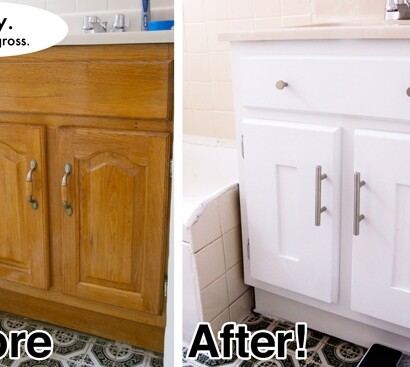
Let’s talk about vanity. Mine specifically, but maybe this chat will affect your vanity as well. I had a big problem with mine. You might too– don’t feel bad, it happens to a lot of people. I’m going to show you how to make it all better.

Vanity. What a dumb word for that janky cabinet under your sink.

If you didn’t catch the big bathroom makeover a couple days ago, you’re really missing out. I’d encourage you to scroll your ass down the page and peruse. Because *spoiler,* we’re totally gonna learn how to do this now.

Now, given that we’re renters and I have a strong-held policy of not asking permission for anything, I was serious about doing this right. The biggest obstacle was figuring out how to deal with those doors– I mean, even after a coat of paint, they’d still be pretty… blah. And the goal isn’t really “less ugly,” now is it? Let’s shoot for the stars. Can I hear an AMEN?!

Then I stumbled upon these in the hardware store:

These are 4 inch wide, 4 foot long, 1/4 inch thick planks. Only $5.99. They’re just wide enough to cover that ubiquitous carved detail that was haunting me. Perfect. Note: I’m not sure if most hardware stores or that hellhole, Home Depot, sells these babies, but craft and hobby stores probably do. If you’re desperate, you could get Home Depot to cut down some luan for the same effect, but you probably don’t want to go thicker than a quarter inch.

Now, THE TOOLS:

You’re gonna need:

  • small foam roller
  • small foam brush
  • handsaw (a miter box is quite helpful, not completely necessary).
  • wood glue
  • finishing nails
  • nail set ($5)
  • spackle
  • spackle knife
  • sandpaper (medium grit)
  • caulk
  • 1 quart oil-based primer (about $13)
  • 2 cans high-gloss white spray paint ($12)

I honestly thought I took a LOT more photos of the process– evidently they’ve gone missing or I imagined taking them. So numbered steps will have to suffice.

1. Remove any existing hardware and wipe everything down with rubbing alcohol, which will make the primer adhere better. Take off the doors and save them for later.

2. Apply your primer to the vanity, sans doors. I used Zinsser oil-based primer, using a small foam roller and a small foam brush. I prefer brush-painted furniture, but the roller will help you achieve that mass-produced look that your landlord is less likely to notice. Now, I’d never used oil-based-anything because I was scared of the cleanup, so I just used supplies I could throw away. But it’s AWESOME. It adheres so much better than latex, it’s kind of unbelievable. I’d recommend thinning it out a bit with some Penetrol, which will help smooth out the brush stroke/roller texture.

2. Lightly sand after your first coat with a medium or fine grit paper to help smooth things out even more. Then wipe it down with a damp cloth, you don’t want that dust in your paint.

3. Paint a second coat of primer, let dry, and sand again.

4. This is where it gets crazy and I WISH I had a picture. I used high-gloss Krylon white spray paint as the final coating. This was purely a personal choice and experiment, but to my knowledge not a lot of finishes will be much smoother or even than spray paint. You could definitely use paint and polyurethane, too, but I wanted to get everything as absolutely smooth as humanly possible. Since I couldn’t move the vanity, I put newspaper and tape over EVERYTHING nearby, then did a bunch of layers of spray paint (many light, even passes are much better than trying to get it done in a couple heavy coats).

5.  Now, the doors! Measure your wood planks and cut them to size using a handsaw or a chop saw if you’re a lucky bastard. Sand the cut edges, they’ll be a bit rough.

6. Glue the wood planks to your doors and use finishing nails to affix them. I used about four nails on each plank, one near each corner (don’t get too close, you don’t want your wood to split!).

Excuse the crap iPhone pic, part of a secret texting correspondence between Eva and I.

7. Use a nail-set to sink the heads of your nails below the surface of the wood. I can’t stress how important this step is, nothing would ruin your finish like a bunch of little bumps where your nail heads are.

8. Spackle over the nail holes and the transitions between the wood planks. You can still kind of see the seams on my finished doors, but it’s subtle. Sand your spackle, repeat the process if it doesn’t seem smooth.

9. Caulk the interior of the new central cutout on the doors and around the edges where the new wood planks meet the original face of the cabinet (make sure you’re done spackling since you can’t sand caulk!). Prime the doors as you did the rest of the cabinet, remembering to sand between coats. Pay special attention to the new cutout so that primer doesn’t pool in the corners.

10. Spray paint the doors a ton of times. I only spray painted the door fronts and painted the back of the doors and the interior of the cabinet with Benjamin Moore semi-gloss white latex trim paint. Remember, it’s okay to paint latex over oil, just not the other way around.

11. Replace the doors and attach your new hardware! I saved a few bucks by reusing the old hinges, spray painted silver. Usually I hate silver spray paint, but for small applications like this it doesn’t bother me. I stuck with 3-inch door pulls (Home Depot), but since the old screw holes are only visible from behind (since you’ve covered the fronts), it might be a nice opportunity to switch things up with knobs or wider pulls. The knobs are the ATTEST from IKEA. I wanted to hang the knobs directly above the middle of the cutouts on the doors, so I used a level  and tape measure to get everything spaced correctly and level. A little anal but, well, it’s the little things, right?

Scrubadub

I’m a dirty, rotten little tease. Over a month ago I got to talking about the bathroom. I made it sound like an exciting before-and-after was just around the corner. Understandably, you were on the edge of your seat. Or at least you should have been.

Well, all those little details I wanted to wrap up before the bathroom’s blog debut just took a while, that’s all. But it’s about as done as it’s going to get, so find a comfy spot to plant yourself, there’s a lot to look at. Let’s start by taking a trip back in time to reacquaint ourselves with the old john, shall we?

View from the outside, from May (you can see a current incarnation of that wall here).

This is a really, really small bathroom. The longest wall measures just over 6 feet and the wall with the window is just over 3.5 feet. The door is on a 45 degree angle, so it’s not even a rectangular 6′ x 3.5′. I’m pretty sure this makes our bathroom about this much bigger than a coffin. Consequently, it’s difficult to take good photos. Basically, this off-white/beige tile wraps around the entire room until about 2 feet below the ceiling, where it was thoughtfully contrasted with off-white/beige paint.

The window casing made me want to cry. I mean, that’s just a sad, spackly mess.

The light fixture had been painted over tons of times and also looked like it might fall down. I assume it once had a glass globe that some careless previous tenant broke. Oh, and that towel rod was a problem because fluffy towels made a narrow space even narrower (the toilet sits in the cozy 19 inches between the tub and the wall) and nobody likes a towel all up in their space when they’re trying to… finish their crossword puzzle.

Yeah, we have some funky tiles happening on the floor, and even though they’re horribly uneven, cracked, and nestled among disgusting grout, I think they’re sort of special. Like a tribute to our landlord’s Italian heritage. You know what’s not special? The hollow-core door all weathered from years of moisture, that clunky wood vanity, the ugly hardware, or the peeling silver-painted pipe. Or our landlord’s apparent love of putting grout where caulk ought to be.

So. Y’ALL READY FOR THIS?!

The walls are painted Benjamin Moore’s “Raccoon Fur” in eggshell. I LOVE this color– it’s somewhere in between a black, a charcoal grey, and a navy without being too blue. It works really well with the tiles on the floor, makes the ceiling feel taller, and just generally makes the bathroom less bland, which is hard to do when you have all that wall tile working against you. The ceiling is Benjamin Moore’s “Simply White” in eggshell, and the trim is all off-the-rack BM white in semi-gloss. I added that little bit of trim around the window to cover up the spackle craziness using a 1/4″ x 2″ x 4′ “project board” I purchased at the hardware store for $4 and cut with a hand saw. I’m not a huge fan of the amount of overhang of the top piece on each side (one of those things that looked better in my head), but I do like the way it cleans up that area.

I’ve yet to find a bathmat small enough (and not for lack of effort), so right now we’re working the Ikea Signe rug, folded into thirds.

Yes, you saw that right. I PAINTED THE MOTHAFUCKIN VANITY. No, I did not ask the landlord. No, I don’t feel bad. I’ll let you know how much of the security deposit I get back when that time comes, but I’m (foolishly, probably) not too worried. That drawer isn’t real, but I picked up some Ikea Attest knobs (brushed finish) anyway with the intention of hanging a nice little tea towel off one of them when I find a cute one. The door pulls are 3-inch stainless steel from Home Depot. I’ll do up a little how-to post about the vanity makeover (yes, they’re the same doors!) since this post is already super long, so get psyched for that.

The pipe got painted, too!

Purely for the sake of luxury and glamor, I splurged and bought this $39 shower curtain from Bed Bath and Beyond. It’s a bamboo-cotton blend that’s nice and heavy and soft without an ugly or overwhelming texture.

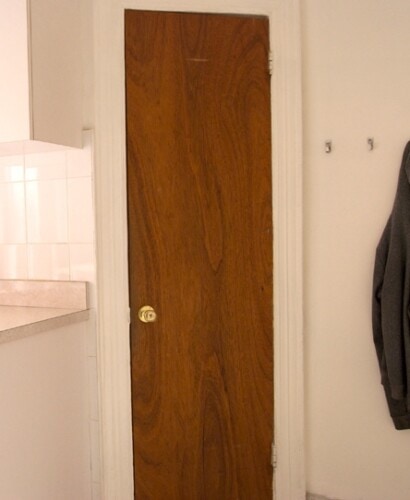
I also painted the crappy hollow-core door. I also did not ask first. I used an oil-based primer (it adheres better and is more durable) and finished with more of the off-the-rack BM white trim paint in semi-gloss (2 coats). I also replaced the crappy old doorknob. The door never closed properly before, and then the plastic-and-brass knob broke entirely (a spring came flying out of it once! boy, that was exciting.), so this was necessary. Turns out it’s really nice to shut the door with confidence that it won’t go drifting open when you’re trying to rinse the shampoo out of your hair.

I opted to take the towel rod out altogether (I kept it so it can be replaced when we move) and use these Ikea folding hooks on the door instead. I hate folding towels and I actually like the more casual look of hanging them, so this works out well. And it definitely makes things seem bigger having them more out of the way.

Lastly, I replaced the light with a $15 vintage specimen from Green Village in Brooklyn and another one of those little Westinghouse ceiling medallions ($6).

I didn’t keep super careful track of every little thing that went into this little less-than-20-square-feet room, but here’s my best attempt at a detailed budget breakdown. Let me know if it looks like I missed anything!

BM “Raccoon Fur,” quart: $15.

BM off-the-rack white semigloss, quart: $13

Window Trim: $4

Vanity Makeover: $53

Shower Curtain: $39

Doorknob: $15

Ikea Enje Roller Shade: $20

Light fixture and medallion: $21

Towel folding hooks: $10

TOTAL: $190

So it’s certainly not perfect (hey, we’re still renters after all), but the bathroom is actually sort of pleasant now! And it’s not just that dazzling needlepoint full of friendly woodland creatures, but that doesn’t hurt either.

City Stargazing.

Astronomy is cool, you guys. So when the earth passed between Jupiter and the Sun a couple weeks ago, I wasn’t about to miss it. Fortunately, the High Line Park played host to the Amateur Astronomers Association, whose members schlepped their big-ass telescopes to the Meatpacking District so commoners like me, Eva, and my friends Maya, Emily and Harriet could look at Jupiter in all its many-mooned glory.

The brilliant work of Diller Scofidio + Renfro, the High Line is built upon the old elevated train tracks on the west side of lower Manhattan, out of use since 1980. Construction on the park didn’t begin until 2006, and the intervening years saw the abandoned tracks reclaimed by nature, inspiring calls for its destruction. But as Alan Weisman eloquently writes in The World Without Us (which is a great book, by the way):

So many New Yorkers, glancing down from windows in Chelsea’s art district, were moved by the sight of this untended, flowering green ribbon, prophetically and swiftly laying claim to a dead slice of their city, that it was dubbed the High Line and officially designated a park.

Now open to the public (partially, a big northern chunk is still under construction), the High Line re-imagines traditional notions of urban public space and challenges our very definition “park.” Architecturally, it’s a gorgeous space– mixing poured concrete, steel, rusted iron, wood, and glass, and then setting these industrial materials against indigenous plants (which, admittedly, were destroyed during the revitalization and replanted with a nod towards an untended, natural aesthetic). It’s an embodiment of the type of urban planning so often discussed but so rarely acted upon: the clever reuse of an unutilized space that embraces its physical limitations while beautifully maximizing its potential for leisure, recreation, a quiet stroll, a private view, a public display. If you live in New York and haven’t been, go. If you’re planning a trip, work it into your itinerary… if for no other reason than to get yourself out of Midtown. It’s super beautiful in the daytime or at night, and WAY different depending on what time of day you go; I might be partial to night. I’ll stop babbling. Let’s just look at some pretty stuff.

These benches! Poured concrete, wood slats, steel support.

One of the bi-level bits that goes through a building. The blue neon is awesome at night.

The Standard Hotel, designed by Todd Schliemann, floats above the park on two concrete supports. Stunning building on the inside and out.

The Frank Gehry IAC building. Definitely awesome.

Possibly my favorite part of the park, this large seating area sits directly above 10th Avenue. This is one of four enormous glass panels.

I promise I’ll get back to the regularly scheduled programming of before-and-afters, DIYs, and recent acquisitions very soon. It’s been a whole week! The shame.

Life
Tagged:
Back to Top